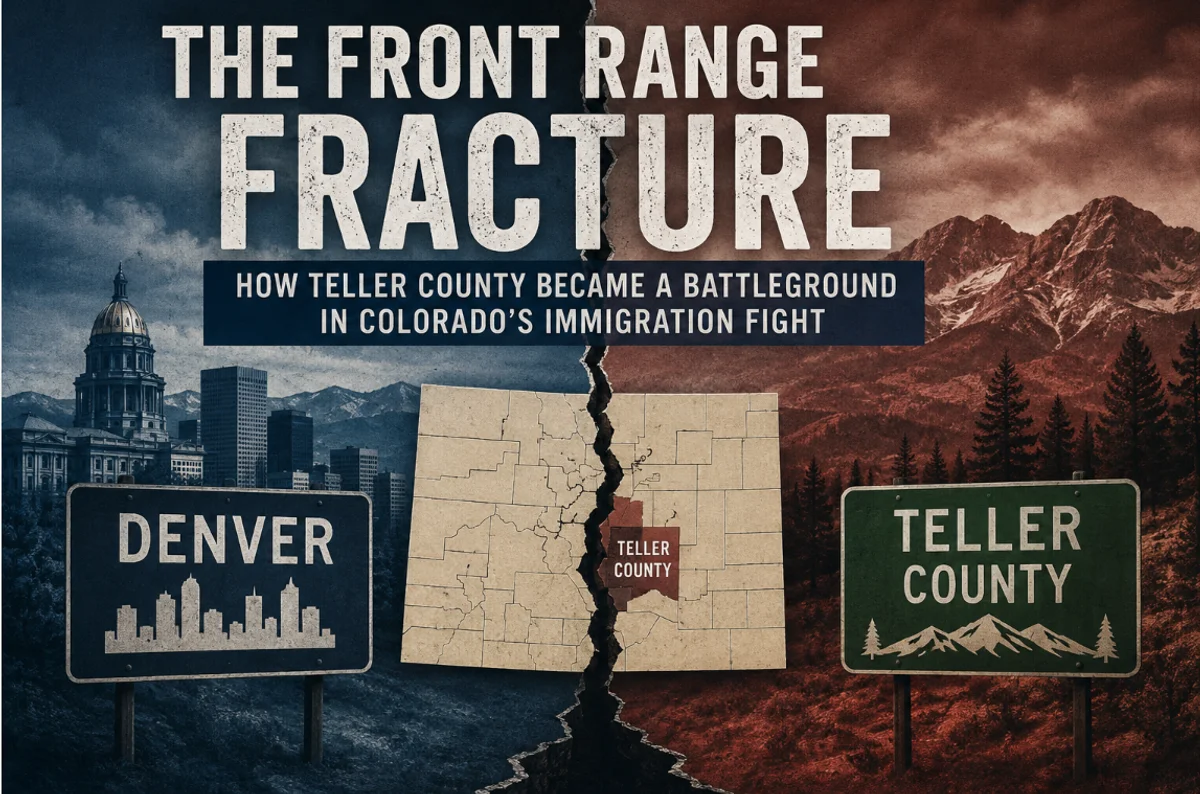
The Front Range Fracture: How Teller County Became a Battleground in Colorado's Immigration Fight
- CRIPPLE CREEK, Colo. — In the mountains west of Colorado Springs, a rural county of roughly 25,000 people has found itself near the center of a much larger fight over immigration enforcement in Colorado.
Teller County has repeatedly challenged the direction coming from Denver, where state laws limit how local law enforcement agencies can cooperate with federal immigration authorities. Sheriff Jason Mikesell and county commissioners have instead defended local cooperation with U.S. Immigration and Customs Enforcement, arguing that state restrictions interfere with law enforcement and local control.
The disagreement has put Teller County on the opposite side of an increasingly sharp divide stretching from Denver through Douglas and El Paso counties and into the communities surrounding Pikes Peak.
But for Teller County leaders, the debate is no longer simply about immigration. It is about who gets to decide how local law enforcement operates — and whether rural counties could ultimately pay a financial price for state policies they openly oppose.
Teller County's Long Fight Over ICE
Teller County's conflict with the state predates the latest national immigration debate.
Mikesell has for years defended the county's cooperation with ICE, including its participation in the federal government's 287(g) program, which allows participating local law enforcement officers to perform certain immigration-related functions under federal supervision.
That relationship also resulted in years of litigation over whether the sheriff could hold people in the county jail for civil immigration violations after they otherwise should have been released.
The case concluded in January 2025 with an agreement permanently ending those detentions, but the broader fight over local cooperation with federal immigration authorities continued.
In April 2025, Mikesell appeared alongside an ICE representative and Teller County commissioners to raise concerns about state laws restricting communication and cooperation between local agencies and federal immigration authorities.
For Teller County, the dispute had increasingly become about something larger than immigration: local control.
A Rural County Pushes Back
That frustration intensified as Teller County leaders argued that rural communities were being forced to operate under policies shaped elsewhere in Colorado.
"Rural Colorado comprises 75 percent of our state and provides considerable economic benefit from recreation to agriculture and ranching," Mikesell said while announcing his campaign for governor in 2025. "Yet rural Colorado is virtually ignored when it comes to state resources."
The divide became particularly complicated when the Trump administration threatened to withhold federal funding from jurisdictions it considered sanctuary jurisdictions.
Teller County commissioners supported federal challenges to Colorado's immigration laws — but also asked Washington not to financially punish counties cooperating with federal immigration authorities because of policies adopted at the state level.
At the time, Teller County received just under $2 million in federal funding, much of it supporting public health and roads.
"All of Colorado should not pay the price for the failures, or even the activist actions, of our legislature and of our governor," Commissioner Erik Stone said. "But that's what's poised to happen. They're going to punish all of Colorado."
The position placed Teller County between two governments: challenging restrictions imposed by Colorado while asking the federal government to distinguish the county from the state when determining potential financial consequences.
Denver Moves in the Opposite Direction
To the north, Denver has taken a markedly different approach.
Denver Mayor Mike Johnston signed an executive order in February restricting the use of city-controlled property for federal civil immigration enforcement and outlining additional protections surrounding federal enforcement activities.
"Our goal is not to provoke but to protect," Johnston said when announcing the order.
Denver officials argue such policies protect residents, preserve trust between immigrant communities and local government and maintain municipal authority over city resources.
Critics south of Denver argue those restrictions hinder federal immigration enforcement and can shift the consequences beyond Denver's borders.
The legal divide intensified in March, when a federal judge dismissed the Trump administration's lawsuit challenging Colorado and Denver immigration policies. The court concluded that the federal government cannot compel state and local governments to implement federal immigration programs.
The ruling added another layer to an increasingly complicated question over which level of government has the authority to determine how immigration laws are enforced.
The Fight Spreads South
Teller County is not alone.
Douglas and El Paso counties sued Colorado over state laws restricting cooperation between local law enforcement and federal immigration authorities. Elbert, Garfield, Mesa and Rio Blanco counties later joined the legal challenge.
The lawsuit was dismissed in 2024, and Douglas County continued the fight on appeal. In April 2026, the Colorado Court of Appeals upheld the dismissal, ruling that the county lacked standing to challenge the state's prohibition on local immigration detention agreements.
In Castle Rock, the divide became even more explicit.
The Town Council approved a resolution supporting cooperation with federal immigration enforcement efforts, putting the Douglas County community squarely at odds with Denver's approach.
The disagreement produced unusually heated rhetoric.
Castle Rock Councilmember Max Brooks characterized Johnston's opposition to federal deportation efforts as "insurrectionist rhetoric," reflecting how far the immigration debate had moved beyond disagreements over individual policies.
The contrast is striking.
Denver has moved to restrict the use of city property for federal immigration operations and strengthen protections for residents during enforcement actions.
Douglas County and other counties challenged Colorado's restrictions in court.
And Teller County has spent years defending its ability to cooperate with ICE while asking the federal government not to penalize the county for state policies it opposes.
What It Means for Teller County
For residents of Teller County, the dispute could have consequences far removed from the southern border.
Federal dollars help support county roads, public health programs and services for veterans, seniors and vulnerable residents. County officials have warned that broad federal penalties against Colorado could reach communities that have actively supported federal immigration enforcement.
At the same time, state restrictions continue to define what local law enforcement agencies can — and cannot — do when working with federal immigration authorities.
That leaves Teller County in an unusual position.
Its leaders want greater freedom from Denver to cooperate with Washington while also seeking protection from Washington when federal action against Colorado threatens local funding.
The contradiction illustrates a larger question now playing out across the Front Range:
How much control should Colorado have over its counties — and how much control should Washington have over Colorado?
For years, immigration debates centered largely on what happened at the nation's borders.
In Teller County, the fight has arrived much closer to home.
And the battle lines now run straight through Colorado.